
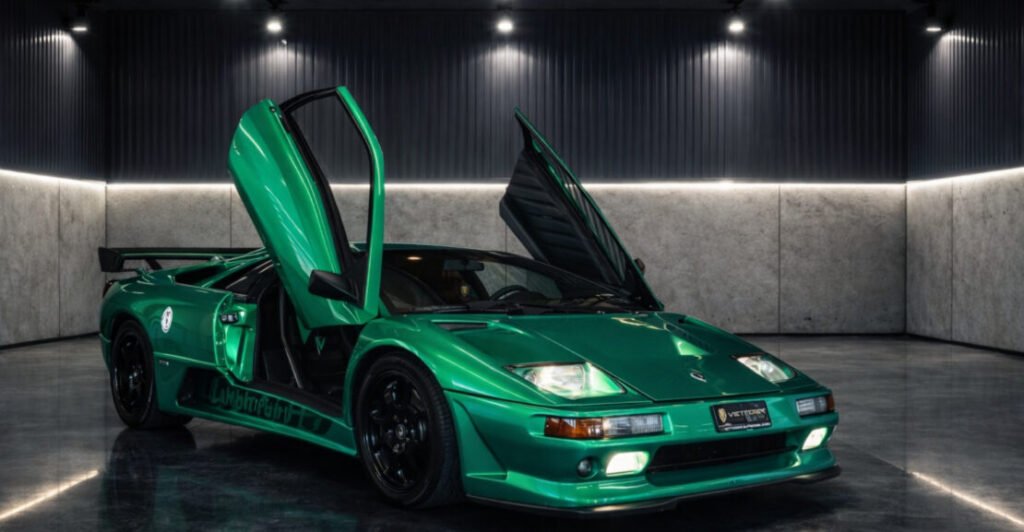
There are few cars that capture the spirit of the analogue supercar era quite as vividly as the Lamborghini Diablo. Introduced at the dawn of the 1990s, the Diablo marked a turning point for the Sant’Agata Bolognese manufacturer — a car designed to carry Lamborghini beyond the dramatic legacy of the Countach and into a new generation of high-performance machines. Bold, uncompromising and unmistakably Italian, the Diablo quickly became one of the defining supercars of its time.
Even today, more than thirty years later, the Diablo continues to hold a special place in the imagination of collectors and enthusiasts. Its dramatic silhouette, naturally aspirated V12 and mechanical purity represent a type of driving experience that modern supercars, increasingly shaped by digital technology and hybrid systems, rarely offer.
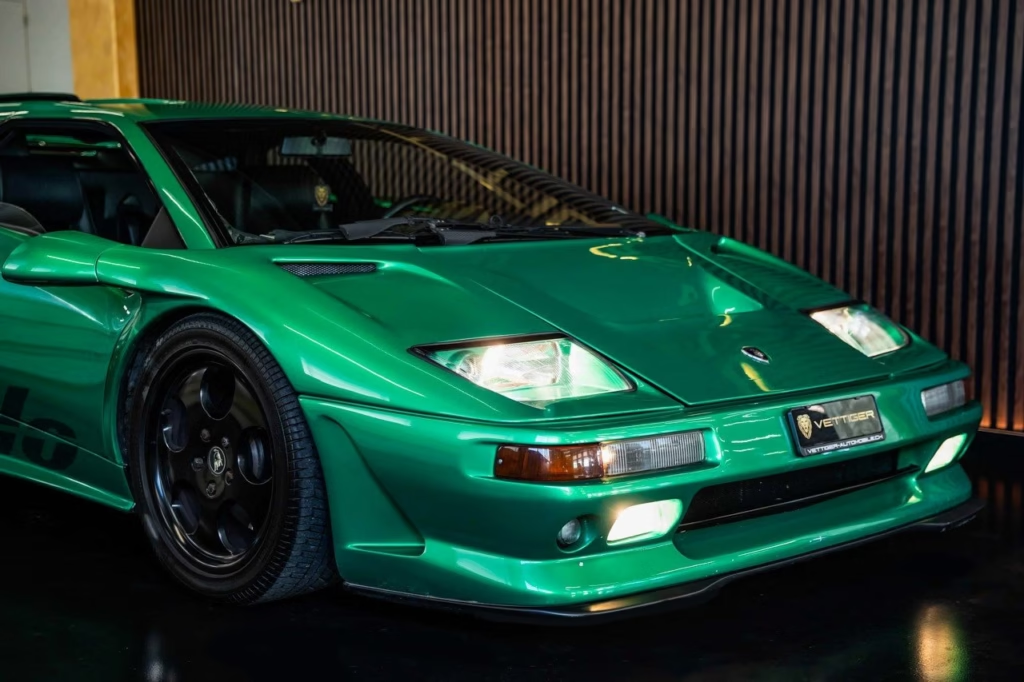
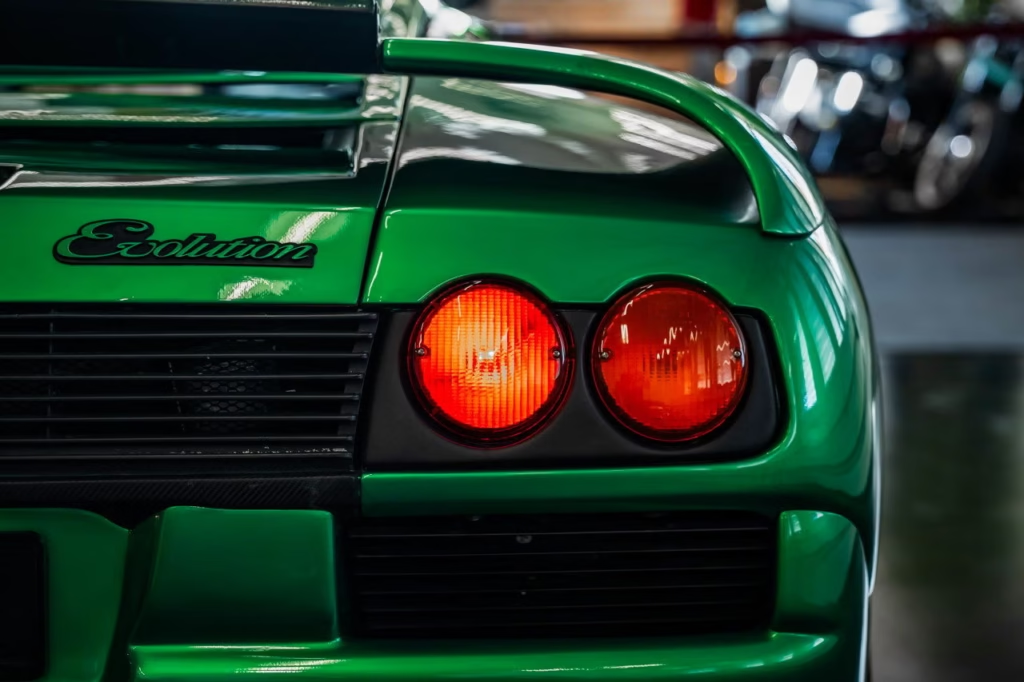
The 1992 Lamborghini Diablo 5.7 Evolution presented here embodies that original philosophy. Finished in a striking green exterior with a black interior, this Swiss-market car reflects the unmistakable presence that defined Lamborghini’s flagship throughout the early 1990s. With 79,500 kilometers recorded and maintained with recent service and inspection, the car stands as a compelling example of one of the most iconic V12 supercars ever produced.
A Supercar That Defined the 1990s
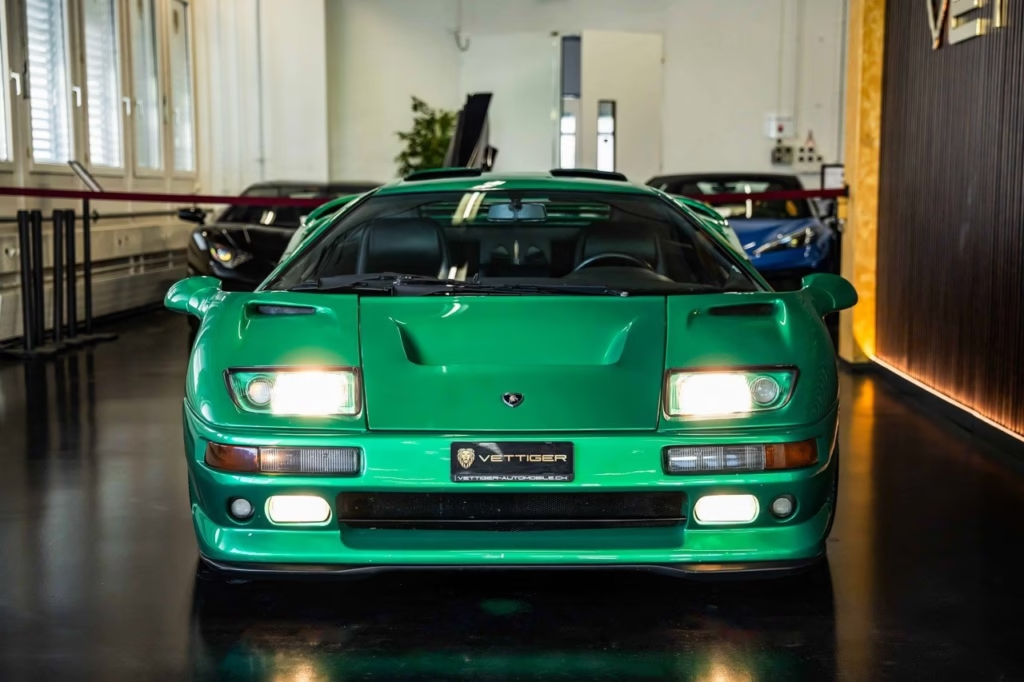
When Lamborghini unveiled the Diablo in 1990, the automotive world immediately recognized it as a new benchmark in the supercar segment. The company’s objective was clear: to build a car capable of delivering extreme performance while preserving the dramatic design language that had become synonymous with the Lamborghini name.
The Diablo succeeded on both fronts. It combined breathtaking speed with an unmistakable visual identity that instantly separated it from other high-performance cars of the era. With its wide stance, long proportions and aggressive air intakes, the car projected power even while standing still.
At the heart of the Diablo lies a 5.7-liter naturally aspirated V12, a defining element of Lamborghini’s heritage. Producing 492 horsepower, the engine channels its power exclusively to the rear wheels through a five-speed manual gearbox, creating a driving experience that is both intense and deeply engaging.
In the early 1990s, this configuration allowed the Diablo to reach performance levels that placed it among the fastest road cars in the world. Yet the Diablo’s true appeal goes beyond numbers. The sound of the V12, the tactile engagement of the manual transmission and the sensation of commanding such a machine all contribute to an experience that remains uniquely thrilling.
Design That Became an Icon
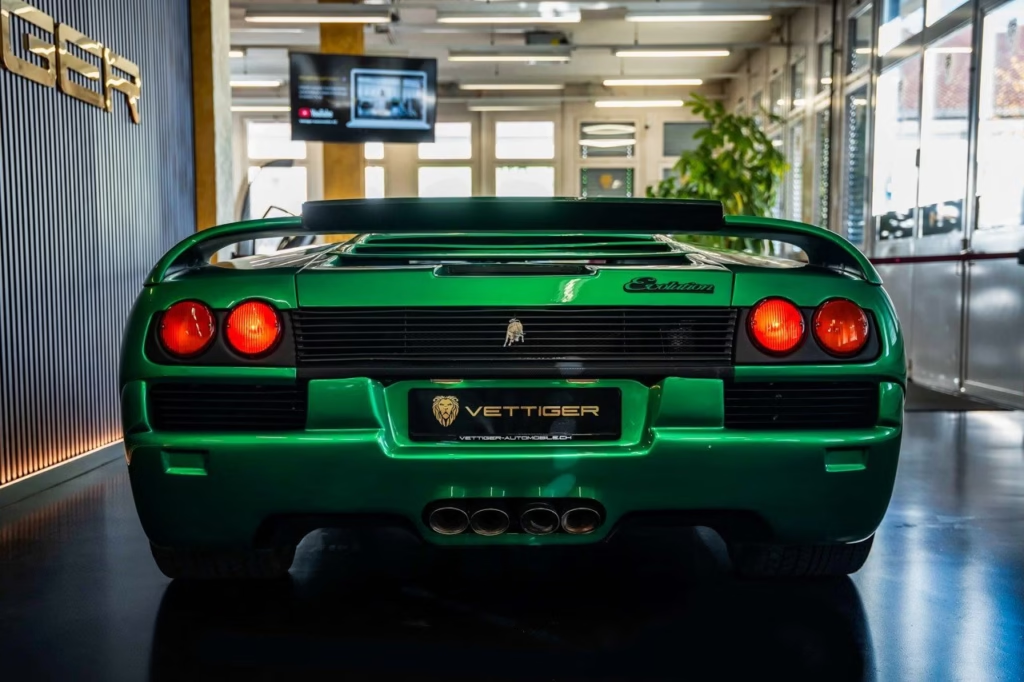
Few silhouettes in automotive history are as instantly recognizable as that of the Diablo. Developed under the creative direction of Marcello Gandini, the same designer responsible for the legendary Countach, the Diablo represents a natural evolution of Lamborghini’s bold design philosophy.
The car’s low wedge profile, dramatic rear haunches and sculpted air intakes create a form that feels both aggressive and elegant. The proportions are unmistakably Lamborghini: a long, low body with a cockpit positioned forward and a powerful rear section housing the V12 engine.
Perhaps the most iconic feature remains the pair of scissor doors, a signature Lamborghini element that transforms the act of entering the car into a theatrical moment. Few design details in the automotive world carry such immediate recognition.
The green exterior of this particular example enhances the car’s already striking presence, while the black leather interior creates a balanced contrast that maintains a timeless aesthetic. Subtle carbon elements add a contemporary touch, complementing the car’s performance-focused character without altering its classic identity.
An Analogue Driving Environment
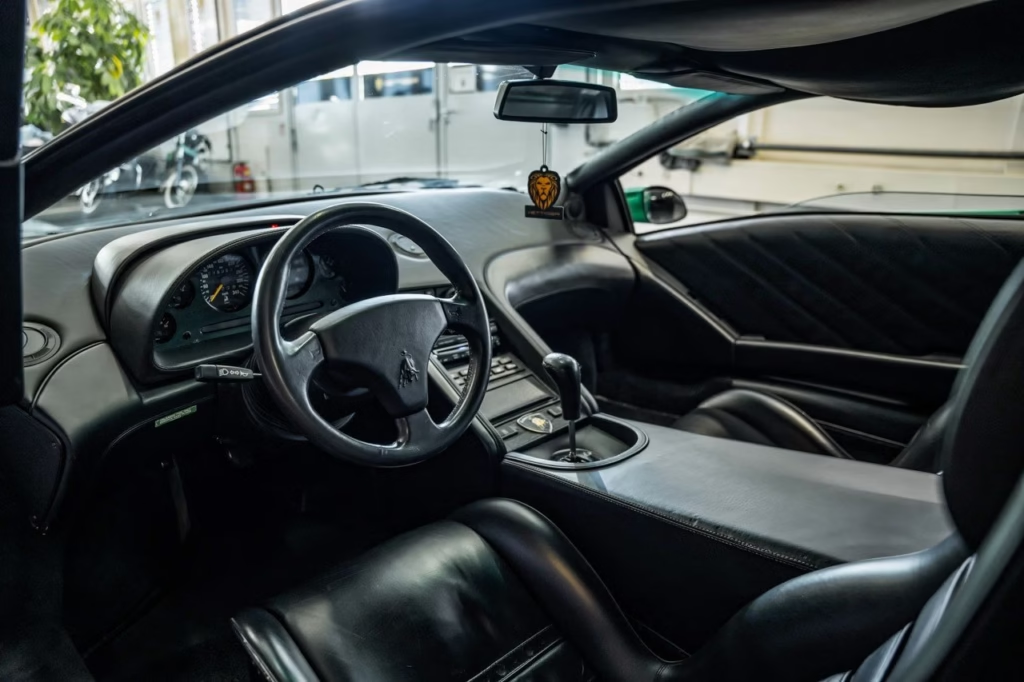
Inside the Diablo, the experience is refreshingly mechanical. Unlike modern supercars filled with digital displays and complex electronic systems, the Diablo focuses on the essentials of driving.
The cockpit places the driver firmly at the center of the experience. Clear analogue instrumentation, a prominent manual gear lever and supportive sports seats create an environment designed for engagement rather than distraction.
Leather upholstery and traditional Lamborghini craftsmanship define the interior atmosphere, while practical features such as air conditioning and electric windows ensure the car remains comfortable enough for longer journeys.
What ultimately defines the Diablo interior is its sense of authenticity. Every control, every sound and every mechanical sensation contributes to a driving experience that feels direct and unfiltered.
The Diablo in Lamborghini’s Evolution
Within Lamborghini’s historical timeline, the Diablo represents a fascinating chapter. It arrived as the successor to the Countach — one of the most radical supercars ever built — yet managed to refine the concept without sacrificing the drama that defined the brand.
Throughout the 1990s, the Diablo evolved through multiple variants, each pushing performance further while maintaining the car’s unmistakable identity. The model remained Lamborghini’s flagship until the introduction of the Murciélago in the early 2000s, which marked the beginning of a new technological era for the brand.
Today, the Diablo is widely regarded as one of the most important Lamborghini models of the modern classic period. Its combination of dramatic design, naturally aspirated V12 power and analogue driving dynamics has secured its place among the most celebrated supercars of the decade.
Early rear-wheel-drive examples such as this one are particularly appreciated by enthusiasts for their purity and mechanical authenticity.
A V12 Supercar for the Modern Collector
As the automotive world continues to move toward electrification and increasingly digital driving experiences, analogue supercars from the 1990s have gained new significance among collectors.
Cars like the Lamborghini Diablo represent a time when supercars were defined not by software but by engineering, sound and raw performance. They offer a level of engagement that is becoming increasingly rare in the modern automotive landscape.
The Lamborghini Diablo 5.7 Evolution presented here captures that era perfectly. With its iconic design, naturally aspirated V12 engine and manual transmission, it delivers an experience that remains as thrilling today as it was when the car first appeared on the world stage.
Combined with its Swiss provenance, distinctive specification and well-maintained condition, this Diablo represents a compelling opportunity to acquire one of the most memorable supercars of the 1990s.
For enthusiasts who value authenticity, drama and mechanical character, the Diablo continues to stand as one of Lamborghini’s most captivating creations.
Vehicle Details
Model: Lamborghini Diablo 5.7 Evolution
Year: 04/1992
Mileage: 79,500 km
Specification / Configuration: Green exterior, black leather interior, rear-wheel drive, 5-speed manual transmission, naturally aspirated V12 with 492 PS, carbon details
Location: Switzerland